Launching the Explore framework with Natural England and Local Partnerships
Angela Jones, President of ADEPT and Director of Thriving Places at Westmorland and Furness Council, reflects on the recent launch of the Explore Framework. Having chaired the session, which was hosted by ADEPT and Natural England, she shares insights from the speakers and explores how this new approach can help local authorities take a more positive and practical approach to planning.
It was a real pleasure to chair the recent launch of the Explore framework, a project led by Natural England and delivered by a wide partnership with support from ADEPT.
The session brought together colleagues from across local government, academia and our delivery partners, all with a shared interest in how we can plan our places more effectively for the future.
From the outset, there was a strong sense of collective purpose and as I noted when opening the session, this is a moment where collaboration across organisations is not just helpful but essential. The challenges we face, from climate resilience to health inequality, do not sit neatly within organisational boxes and boundaries. They demand a more integrated approach and the Explore Framework has been designed with exactly this in mind.
Explore - a framework that provides joined up thinking
At its heart, Explore is a strategic planning and facilitation tool that helps to bring together different perspectives, data and priorities into a single conversation. It is deliberately policy neutral, focusing instead on enabling better decision making through evidence and collaboration.
Led by Natural England and developed through a partnership including the Environment Agency, the University of Exeter and Local Partnerships; the framework draws on research from the RENEW programme and practical experience from across our sector. This combination of academic insight and real-world testing ensures that the toolkit is both credible and user-friendly.
Dr Jamie McCauley from the University of Exeter set the scene by reminding us just how complex strategic planning has become. Local authorities are balancing competing pressures around housing, nature recovery, economic growth and community wellbeing. Strategic planning, he emphasised, must be an organised, collaborative and iterative process if it is to succeed. EXPLORE reflects this thinking by structuring conversations in a way that helps partners to move from understanding their current position through to shaping future choices and actions.
From complexity to clarity
One of the most helpful aspects of the framework is the way it simplifies complexity without losing essential ‘depth’ and nuance. As Tim Sunderland from Natural England explained, Explore focuses on four shared outcomes:
- Health
- Wellbeing
- Nature
- Sustainability
These act as common reference points, lifting conversations above individual departmental priorities and enabling genuinely strategic discussions that move action forward.
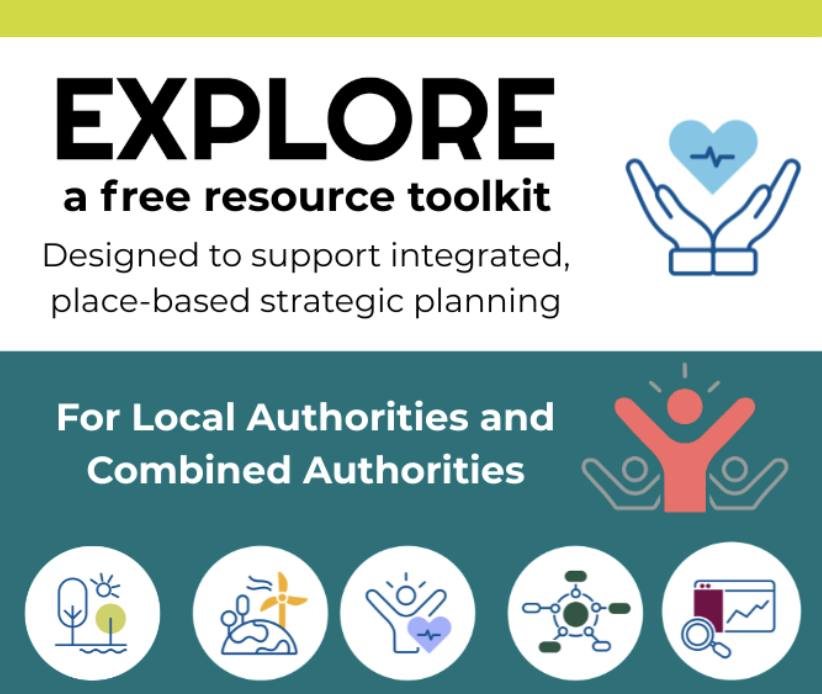
This is supported by four core components, which you can find illustrated in the launch materials:
- outcome dashboards providing a snapshot of performance
- factor maps showing relationships between key influences
- horizon scanning tools to explore future scenarios
- a facilitation package to guide structured workshops
Together, these elements create a practical toolkit that can be used to bring partners together and identify shared priorities.
What stood out for me was the emphasis on accessibility. The data is presented in a way that can be understood by both specialists and those new to the initiative, reducing barriers to participation.
This is critical if we are to get the right people in the room together for meaningful, purposeful conversations.
From conversations to action points
A recurring theme throughout the session was the need to move beyond discussion and into delivery, which is why Explore is not just about insight, it is about enabling action.
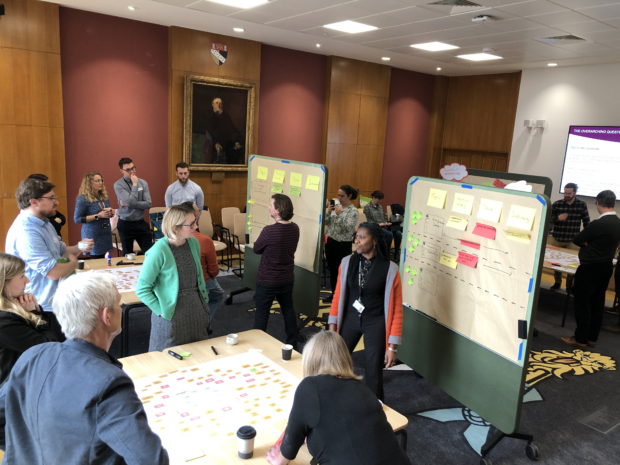
Rachel Toresen-Owuor, Senior Director at Local Partnerships highlighted how the framework supports organisations to design and facilitate workshops that lead to clear outputs and crucial next steps. The structured approach, from defining a focal question through to identifying interventions, helps to ensure that conversations have purpose and that outcomes are focused.
Importantly, the framework also recognises that strategic alignment is the starting point rather than the end point. Once priorities are agreed, further detailed work can follow using other tools and processes. In this way, Explore complements existing approaches rather than trying to replace them.
A local government perspective
Reflections from Carolyn McKenzie, Director of Environment and Planning at Surrey County Council and Chair of the ADEPT Environment Board, brought the framework to life through practical experience.
At the outset, eighteen participants from Surrey County Council, Runnymede, Elmbridge and Spelthorne Borough Councils tested Explore components in the context of planning for the peri-urban geography between the London Boundary and the River Thames Scheme.
Having been involved in this early pilot work for the toolkit, Carolyn highlighted how Explore can help local authorities to navigate the complexities of land use planning, where competing demands on land are a constant challenge.
Her observations showed how Explore can support discussions across partners to identify what matters most for a place and how multiple outcomes can be delivered together.
As Carolyn noted, tools like this can help us make informed trade-offs, grounded in evidence and shared understanding. They also provide an opportunity to align environment, health and economic priorities in a way that delivers better overall outcomes for communities.
The role of ADEPT
The Explore framework aligns strongly with ADEPT’s wider ambitions. We have long championed the importance of place-based leadership and the need for directors to work across traditional siloed departments and boundaries.
Explore provides a practical way to do just that. It supports the kind of collaborative, outward looking approach that is increasingly important in the context of devolution and local government reorganisation. As I reflected during the session, there is a risk in times of change that organisations look inward. Tools like this encourage us to look beyond our established structures and work together.
Moving forwards with Explore
The launch of the Explore framework feels both timely and optimistic. It offers a structured yet flexible approach to tackling some of the most complex challenges facing local government today.
The key messages from the session were clear. We need better collaboration. We need structured strategic conversations. We need to integrate nature and wellbeing into our planning decisions. And we need to use data and evidence to guide us towards the best choice for our communities.
Most importantly, we need to turn those conversations into action.
Explore does not claim to solve every challenge, but it does provide a practical and thoughtful way to bring people together, build shared understanding and move towards better outcomes for our places.
I would encourage colleagues across the sector to look more closely at the toolkit, be open and curious about how it could be used locally for your authority and continue the spirit of collaboration that underpinned its development and launch.
Further information
- Find out more about the Explore framework toolkit here
- Discover more about ADEPT Partners and collaborations here
Author
- Angela Jones, ADEPT President and Director of Thriving Places, Westmorland & Furness Council